I went to see the new Disney Cinderella movie with my family last Sunday.
It
was beautiful. It was fun. It was good. It was exactly what I wanted it
to be. It was exactly what I didn't think movies could be anymore--
sincere. |
| Cinderella emphasizes a kind of strength not often portrayed in movies; a quiet, inner one. |
In response to all of these people, I would like to offer a defense of Cinderella. Not just the new movie (which is amazing-- seriously, go see it), but even the old animated movie.
First, let me state that, while I hesitate to call myself a feminist (because of all the baggage that is often associated with that word), I am certainly a supporter of strong women. I am blessed to have many strong women in my life, and strong, independent women have always been my heroes and my role models.
 |
| Amy Carmichael was a feisty, independent Irish woman who, despite being told she shouldn't travel because of her health, went to India in the early 1900s and almost single-handedly saved hundreds of girls from child prostitution. She has been one of my heroes since I was eight years old. |
At the same time, we were a Jesus-loving, Bible-believing family, and my parents also taught us what the Bible had to say about relationships, about the differences between men and women, and what love and marriage are supposed to look like. One of the most shocking things I've discovered after I grew up is how many people (both feminist and anti-feminist) have twisted the Bible to make it sound anti-woman, when it isn't at all.
 |
| This is one artist's depiction of Deborah, one of the many strong women described in the Bible, who was actually a judge over the whole nation of Israel at a time when women in leadership were almost unheard of. I have always loved her story. |
I think the best way for me to explain this (apparently radical) belief of mine is to dispute, one by one, the negative claims others have put forth about Cinderella and her story. The three main arguments against Cinderella that I often hear are:
1. Cinderella is a weak, passive character who has no personality and does nothing to drive her own story.
2. Rather than leaving a bad situation or trying to fight back, she stays and accepts abuse, and encourages young girls to do the same. Basically, she is teaching women that it's good to be a door-mat.
3. The Cinderella story teaches that the only purpose of women is to be desired and rescued by men. It is just another sexist narrative about a handsome prince rescuing a helpless female.
I don't agree with any of these claims, and actually have a lot to say in response to them. In order to keep my posts from becoming too long, I am going to address each complaint against the story in a separate post, so this will be a 3-part series. In this post, I will address the first objection to Cinderella:
Cinderella has no personality and/or she is weak and passive and her story is all about things that happen TO her; she does nothing to drive her own narrative.
Even the reviewer I mentioned above who praised the new movie seemed to think this, especially about the animated version.
Respectfully, I must say this is absolute poppycock.
First of all, I do admit that Cinderella has a different personality in the cartoon as opposed to the live-action movie, but not less of one. I do like the personality of the new Cinderella better, but not because it is "stronger." In fact, the old Cinderella actually might be "stronger" by modern feminist definitions. She certainly is more feisty. She starts out the movie by yelling at a clock for waking her up. She resists and tries to argue with her stepmother on multiple occasions. She slyly mocks her stepsisters behind their backs, making a sarcastically gleeful face when she mentions their "music lessons" to the mice. She threatens Lucifer (the cat) with a broom. She works to make her own dress so that she can go to the ball and insists that she should be allowed to go. After her stepsisters destroy her dress and her stepmother makes it clear she is not allowed to go to the ball, she goes anyway! When her stepmother locks her in her tower room, she actively tries to escape by urging the mice to get the key for her, and when Lucifer tries to stop them, she calls the dog to chase him off. This is just a short list of the many things she does to drive her story forward. If you really think she doesn't have a personality, I recommend you watch the animated movie again, try not to get distracted by the singing mice, and really pay attention to what Cinderella is doing and saying, and especially to her very expressive face.
 |
| Does this look like a passive face to you? |
The old movie was basically the same old Disney mantra as usual: Believe in your dreams hard enough, and they will come true! There's nothing wrong with this idea, per se, but I don't believe it is ultimately as profound as the theme of the new one. "Believe in your dreams" is very self-focused. If that's your priority, then anyone who inhibits your dreams (in animated Cinderella's case, this includes the clock, her stepfamily, and Lucifer) will inevitably make you frustrated. You will feel like you have a right to complain about them, argue against them, and mock them, because they are keeping you from your dreams, and your dreams are of the ultimate importance.
The new Cinderella, on the other hand, doesn't have any grand dreams. She just wants to live peacefully in the house where she grew up, cherishing and honoring the memory of her beloved parents. She doesn't see her stepfamily as an obstacle, but an opportunity; a chance to prove that, even in the most difficult of circumstances, she can have courage and be kind. Does she hope that someday things will change and get better for her? Probably. But, astonishingly, she is patient. She believes that if she is kind and courageous, things will work out in the end. Patience is a virtue little known in our society, but it is one we could all benefit from. No matter what we do, we often can't force our circumstances to change overnight.
When she feels frustrated with the way she is being treated, she doesn't lash out in anger. She goes for a horse-back ride to get away. She reminds herself that her stepfamily don't seem to have had the benefit of learning what kindness was at an early age, like she did, and that others have it much worse than she does.
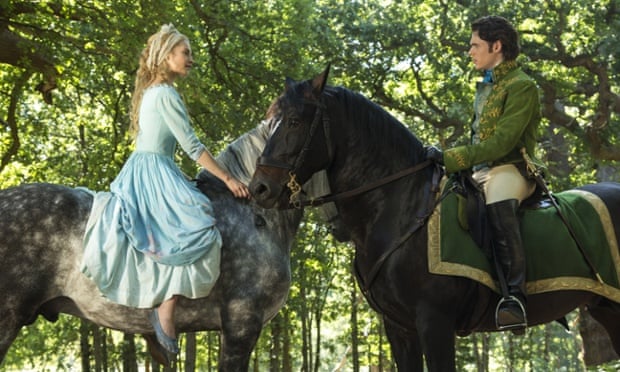 |
| When she meets the prince during her ride, she doesn't try to hide from him the difficulty of her situation, but she bravely points out that she still has a lot to be thankful for. It's no wonder he's immediately smitten by her. |
As a follower of Jesus, I feel that Cinderella openly lives by Jesus' teaching: "But I tell you, love your enemies and pray for those who persecute you." (Matthew 5:44). This is why I can never think of Cinderella as a "passive" character. Treating others kindly and choosing to forgive them are ACTIONS, and very difficult ones. And, the most impressive thing about this inner strength is that no one can take it away from you. Even if you are completely trapped by circumstances, you can always choose to be kind and courageous, and even if that doesn't change the world around you for the better (though it often does), it will at least change you for the better. If this kind of inner strength and ability to see the best in everything is what it means to be passive, then I think more people need to be "passive." Maybe the world would be a better place.
In my next blog post, I will address the second criticism that I hear a lot of people make against this story: "Why didn't Cinderella just leave? Doesn't her choice to stay with her stepfamily encourage girls to stay in abusive situations?" That's a pretty serious accusation. What do you think?

No comments:
Post a Comment